|
|
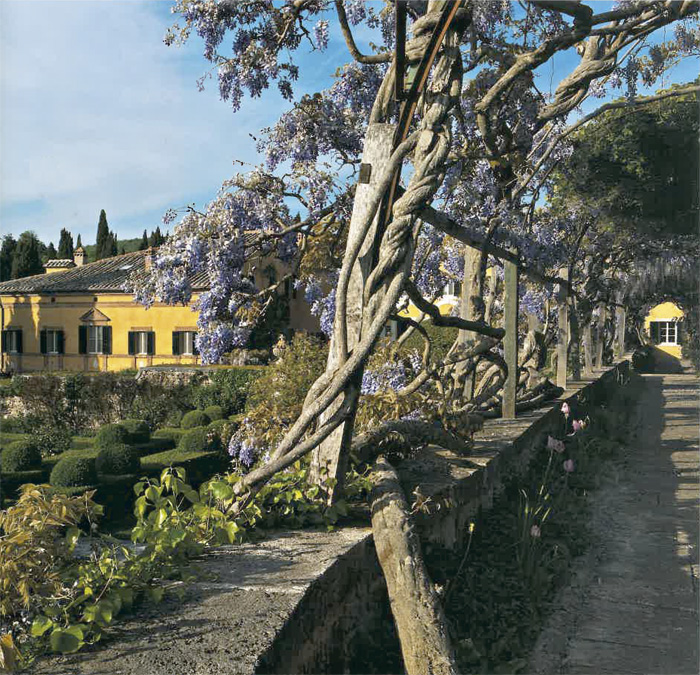
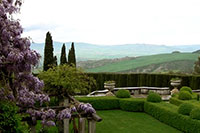
Villa La Foce, Val d'Orcia. A wooden pergola supports a purple flowering wisteria over a stone path
|
![Toacana ] Galleria di immagini](../../titels/albump.gif)

Villa La Foce |
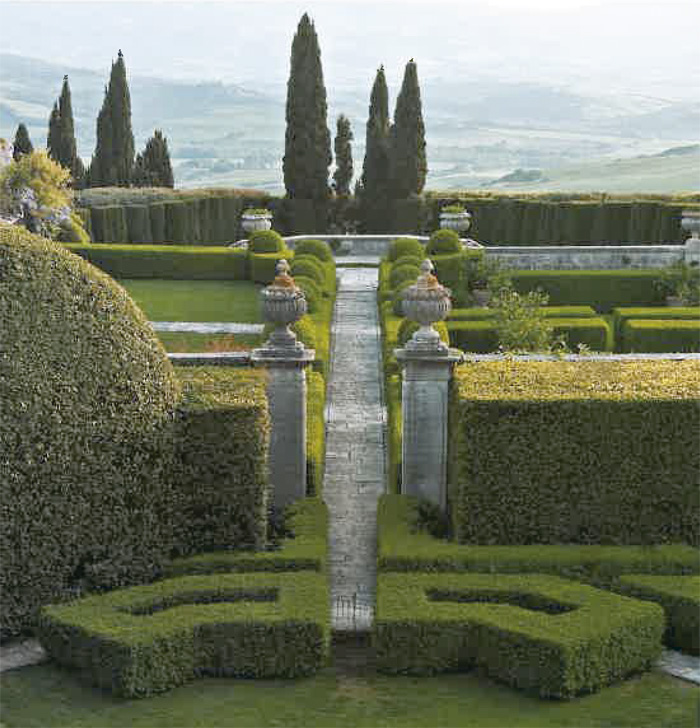
The gardens and estate of La Foce constitute one of the most important and best kept early twentieth-century gardens in Italy. The property of La Foce lies on the hills overlooking the Val d'Orcia, a beautiful and miraculously intact valley in Southern Tuscany. La Foce is a re-created renaissance style garden designed by Cecil Pinsent between 1927 and 1939 for Iris Origo, a writer and horticulturalist. After moving to the area in 1924, the Origos dedicated their lives to the development and progress of the Val d'Orcia and its people. |
|
||
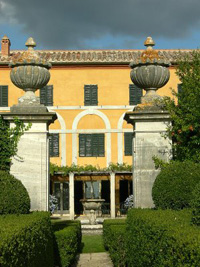
Villa La Foce entrance [2]
|
||
'The Renaissance of the fifteenth century was, as its name suggests, a rebirth, a reworking of all areas of culture and thought. It was seen in the art and writing of the period,: in science, mathematics and philosophy and, in fact, all areas of human endeavour. That included the garden which, in previous times in Europe, almps~ always had a practical purpose, whether that be as a place to grow medicinal herbs or as a small and temporary retreat from the challenges of the outside world. During the Renaissance, which started in Italy, particularly in Florence, before spreading to France, the garden shook off that practical mantle and became an artwork in itself, designed using newly discovered mathematical principles and reflecting the philosophies of the time. Not only did it function as a living artwork but the garden was also seen as a symbol of wealth and power, created as much to impress as for personal enjoyment. |
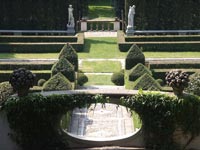
The gardens of La Foce
|
|
| After buying their new home, Antonio and Iris employed the services of English architect Cecil Pinsent. Iris already knew Cecil as he had worked on her mother's house, Villa Medici, in Fiesole, and the nearby house of friend Bernard Berenson, Villa I Tatti. On these two properties Cecil had proved not only that he could design and redesign a home, but also that he was also talented in creating landscapes. Bernard Berenson and his wife Mary bought Villa I Tatti in 1905. In 1909 they commissioned the English architect Cecil Ross Pinsent (1884–1963) to supervise a series of extensions and alterations to Villa I Tatti, as well as to design a garden and supervise its planting and construction with the help of the English writer-scholar Geoffrey Scott (1884 – 1929).
|
 |
|
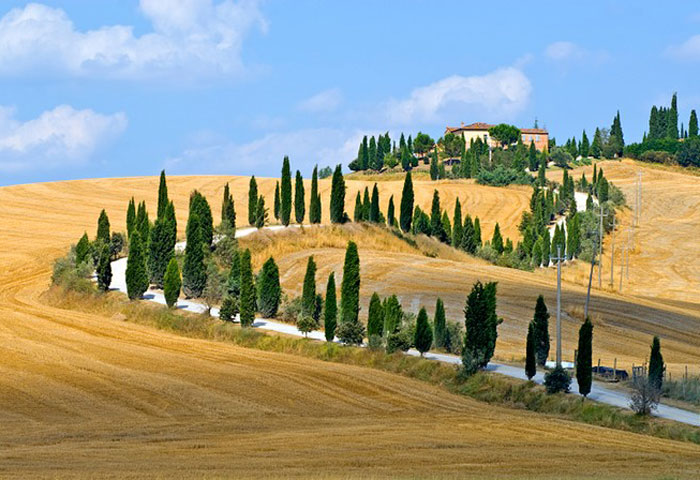
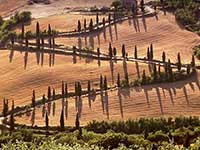
The famous winding road with cypresses, one of the most photographed views of Tuscany. |
||
The beautiful evergreen Italian Cypress tree makes an architectural statement in this famous alley, the famous cypress road that winds up a hill from La Foce towards the Luciabella Nature Reserve.
|
||
 |
||
The cypresses that twine up a hill side near Chianciano Terme have become an emblem of Tuscany. But they also have a story, for they were planted by Marchese and Marchesa Origo as part of a scheme to improve the landscape of what was then among Italy's most desolate regions |
||
Map |
||

Mappa Villa La Foce | Ingrandire mappa
|
||||
One of Tuscany's best kept secrets is the beautiful valley sheltering this recently renovated 18th century farm house, Podere Santa Pia. This former small cloister is the perfect spot to slow travel. Waking up at dawn to start hiking, learning once again the names of flowers and trees, and above all, having the pleasure of getting lost, forgetting about guides, clocks and timetables.
|
||||
 |
 |
|||
Podere Santa Pia, mystic holiday home in the heart of the Tuscan Maremma
|
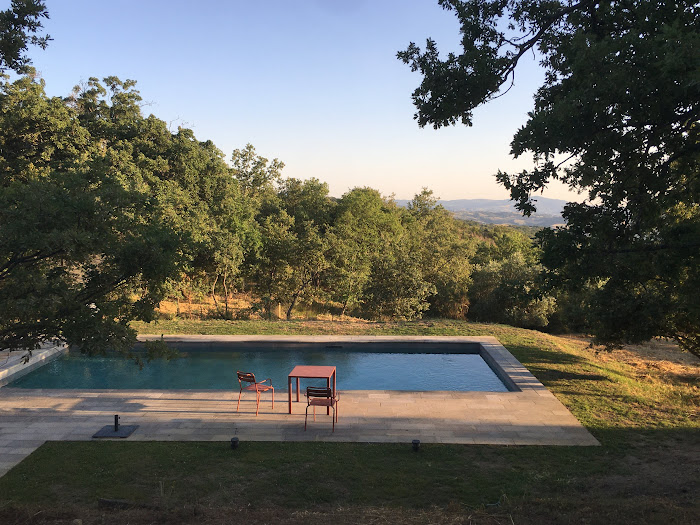
A beautiful early evening by the pool, in the resplendent Tuscan sun, time takes on a languid quality
|
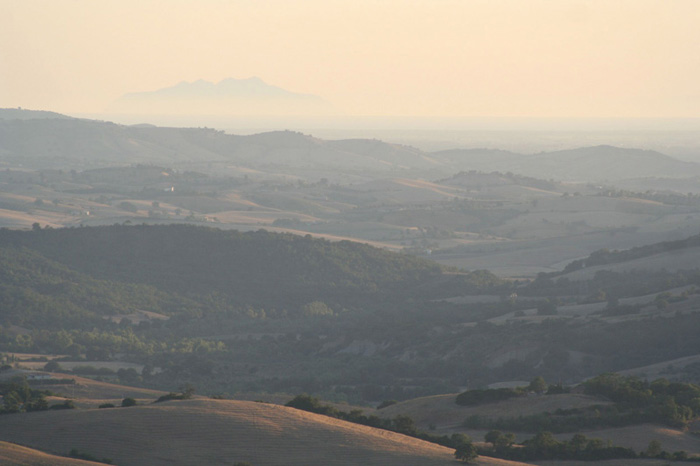
Visia da Podere Santa Pia, fino al mare e Montecristo
|
||
 |
 |
|||
Cipressi nella Val d'Orcia. La storia di Cyparissus nella Metamorfosi di Ovidio
|
Gladiator road, la strada della val d'Orcia diventata famosa
|
Pienza, Via dell'amore
|
||
‘And then, suddenly, a view opens up. The hills recede, slowly and cautiously. You stand still, as if to leave would be a betrayal.’
|
||||
 |
||||
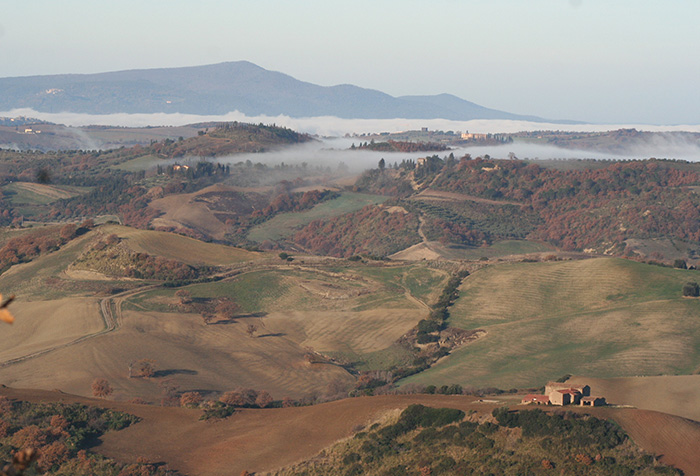
Podere Santa Pia, with an unforgettable view of the Tuscan Maremma
|
||||
 |
 |
 |
||
Podere Santa Pia
|
Podere Santa Pia, garden
|
Villa La Foce
|
||
 |
 |
 |
||
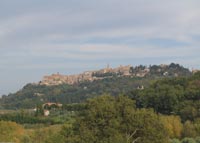
Montepulciano
|
Villa La Foce on YouTube
|
Villa I Tatti
|
||
|
||||
Restaurants Dopolavoro La Foce
|
||||
 |
||||
Podere Santa Pia, morning view on the Maremma from the northern terrace
|
||||
|
||||