![Toacana ] Galleria di immagini](../../titels/albump.gif)

Villa La Foce, the ultimate garden of Iris Origo and Cecil Pinsent
|
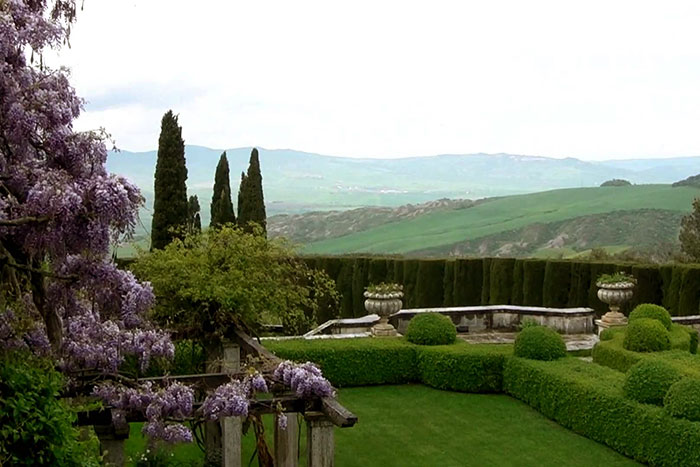
The stunning Villa La Foce is located on a hill overlooking the Val d'Orcia, a beautiful and miraculously intact valley in Southern Tuscany. Villa La Foce was purchased by Antonio and Iris Origo in 1927. They engaged the English architect Cecil Pinsent, who had previously done extensive work on Bernard Berenson's Villa I Tatti in Florence, to restructure the main buildings and create a large garden.
|
Mappa Villa La Foce | Ingrandire mappa
|
||
The Pergola |
||
 |
||
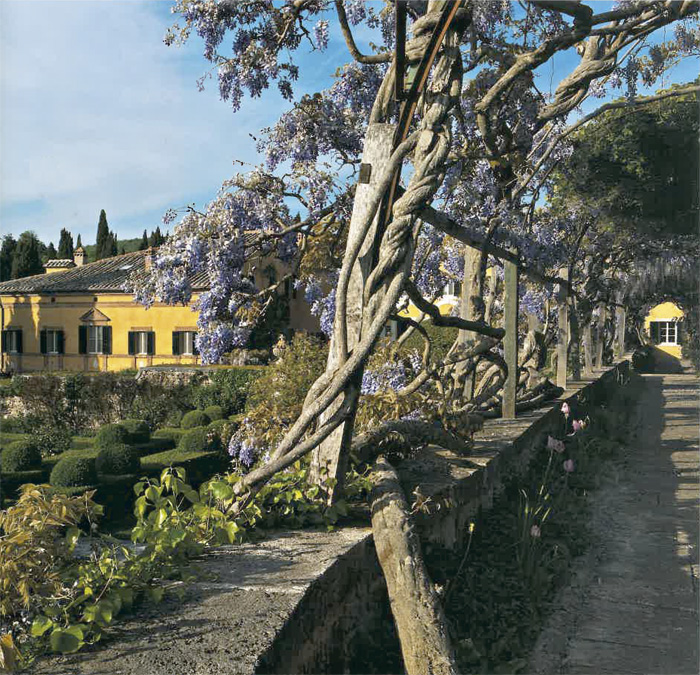
A wooden pergola supports a purple flowering wisteria over a stone path |
||
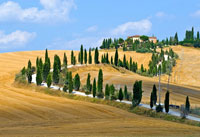
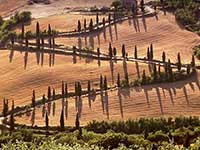
The famous winding road with cypresses |
||
The famous cypress road that winds up a hill, one of the most photographed views of Tuscany. But they also have a story, for they were planted by Marchese and Marchesa Origo (the writer Iris Origo) as part of a scheme to improve the landscape of what was then among Italy's most desolate regions. They also, no doubt, softened the view from the masterpiece the idealistic young couple created nearby, at what had been until their arrival a wayside inn: one of the most dramatic twentieth-century gardens.
|
||
 |
||
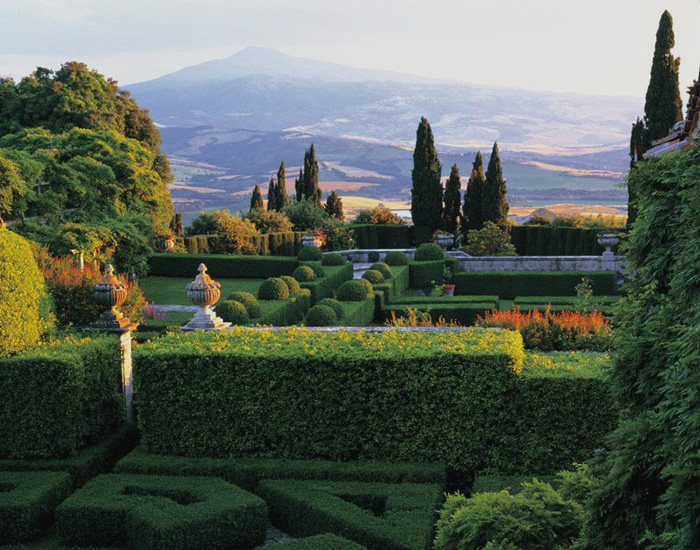
A view across the garden towards a horizon dominated by the volcanic peak of Monte Amiata. View of the formal landscaping below the belvedere in the garden at La Foce in Tuscany. The harmony between this garden and the surrounding nature makes la Foce an ideal example of Tuscany’s architectural and cultural evolution in the 20th century. |
||
Cecil Pinsent was renowned for his ability to combine Italian Renaissance traditions with English garden design principles. This is clearly evident at La Foce: the boxwood hedges provide a formal, architectural framework, whilst roses, lavender, wisteria and other flowering plants soften the garden with colour and fragrance. The geometry of the boxwood thus forms the stable framework against which the richer planting can shine.
|
||
 |
||
Cecil Pinsent’s low, neatly trimmed boxwood hedges at Villa la Foce, Chianciano Terme, Val d’Orcia [3]
|
||
The box hedges at La Foce are therefore much more than mere partitions. They form the green framework of a garden considered one of the finest examples of twentieth-century garden architecture in Italy. Through their understated elegance, they unite architecture, garden and landscape into a single harmonious whole – precisely the ideal that Cecil Pinsent had in mind.
|
||
| La Foce has also become a centre for cultural and artistic activities. Castelluccio (literally little castle), a mediaeval castle on the property, is the home of an international music festival, Incontri in Terra di Siena. It also hosts art exhibitions, as well as courses on garden history and landscaping. Each summer, the cultural association La Tartaruga organizes art shows at the medieval castle Castelluccio. The curator, Plinio de Martiis (known for his important gallery in Rome) has in recent years brought the work of renowned artists such as Kounellis and Manzoni to Castelluccio, as well as promoting young, less famous artists. Incontri in Terra di Sienaa is a chamber music festival with an eclectic programme featuring internationally-known musicians in the incomparable settings of Villa La Foce and the Val d'Orcia. Artistic Director Antonio Lysy brings together rising stars alongside world-class musicians. Based at Villa La Foce and the nearby medieval castle, Castelluccio, Incontri's aim is to spread the appreciation of music and art through concerts, meetings, and artistic events held in the many beautiful neighbouring towns that include Pienza, Radicofani, Cetona, Città della Pieve and San Quirico d'Orcia. The Incontri in Terra di Siena is a key part of a wider initiative to sustain the area, the passion that originally drove Antonio and Iris Origo.
|
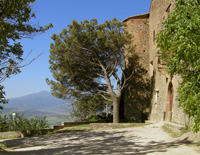 Castelluccio |
|
Incontri in Terra di Siena Festival | ITS 2024 Festival Highlights
|
||
|
Galleria fotografica Val d'Orcia
|
||||
 |
 |
|
||
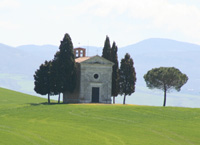
Cappella della Madonna di Vitaleta, nei pressi di San Quirico d'Orcia
|
Cipressi e la Cappella della Madonna di Vitaleta, tra Pienza and San Quirico d'Orcia
|
Castelluccio
|
||
Cipressi nella Val d'Orcia
|
||||
 |
 |
 |
||
Cipressi nella Val d'Orcia. La storia di Cyparissus nella Metamorfosi di Ovidio
|
I cipressi e Villa La Foce, l'ultimo giardino di Iris Origo e Cecil Pinsent
|
Ingresso di Villa La Foce.
|
||
YouTube | The beautiful garden of Villa La Foce in the Val d'Orcia, Tuscany
|
||||
|
||||
 |
||||
The best hiking trails in Tuscany | La Foce – Riserva Lucciola Bella – Castelluccio | 12,53 km | gpx Trekking in Toscana | Val d'Orcia | I migliori 10 sentieri per trekking in Toscana | Anello La Foce di Chianciano – Riserva di Lucciola Bella – Palazzone – Castelluccio I migliori 10 sentieri per trekking in Toscana | Anello La Foce to Vetriana and Monte Cetona
Pietraporciana Nature Reserve Riserva Naturale di Pietraporciana (it) (341 ha) | View Natural Reserve in Tuscany of Pietraporciaia in a larger map
|
 Villa La Foce on YouTube |
|||
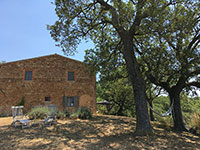
One of Tuscany's best kept secrets is the beautiful valley sheltering this recently renovated 18th century farm house, Podere Santa Pia. This former small cloister is the perfect spot to slow travel. Waking up at dawn to start hiking, learning once again the names of flowers and trees, and above all, having the pleasure of getting lost, forgetting about guides, clocks and timetables.
|
||||
 |
 |
 |
||
Podere Santa Pia, with a unique private swimming pool, celebrare il dolce far niente
|
Reflections on the pool: Tuscan designs for swimming
|
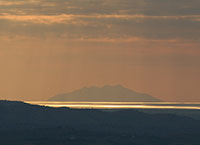
Visia da Podere Santa Pia, fino al mare e Montecristo
|
||
|
||||
 |
||||
A beautiful early evening by the pool, in the resplendent Tuscan sun, time takes on a languid quality
|
||||
 |
 |
|||
Podere Santa Pia
|
Podere Santa Pia
|
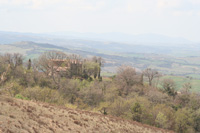
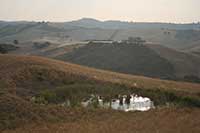
Colline sotto Podere Santa Pia
|
||
|
|
Album Crete Senesi | Album Monte Amiata |
||
 |
 |
 |
||
|
||||
#travelingintuscanySan Quirico d' Orcia, la sua valle e i suoi cipressi.
|
||||
Questo articolo è basato sull'articolo Villa La Foce dell' enciclopedia Wikipedia ed è rilasciato sotto i termini della GNU Free Documentation License. |
||||